

In modern manufacturing assembly, screw locking is a key link that directly affects production efficiency, product quality, and operational costs. With the continuous upgrading of automation technology, two types of screw locking equipment are widely used in global factories: handheld screw locking machines and visual automatic screw locking machines. Many manufacturers are confused about how to choose between the two—they have distinct advantages and are suitable for different production scenarios. As a professional automation equipment manufacturer with 10+ years of experience, Dongguan Sudizhi will comprehensively analyze the core differences between the two types of machines, focusing on their unique advantages and applicable scenarios, to help global customers make the most suitable choice for their production needs. This article is optimized for Google indexing, integrating high-frequency search keywords and practical industry insights to provide valuable references for your assembly line upgrade.
Core Definition: Two Types of Screw Locking Machines
Before exploring the differences, it is necessary to clarify the core positioning of the two machines, which is the basis for understanding their advantages and application scenarios:
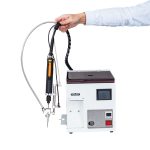
Handheld Screw Locking Machine: A semi-automatic equipment that combines portability and simplicity. It relies on manual operation to align the screw hole, and the machine completes automatic screw feeding and locking. It is a “human-machine collaboration” solution that balances flexibility and efficiency, suitable for scenarios where manual intervention is required.
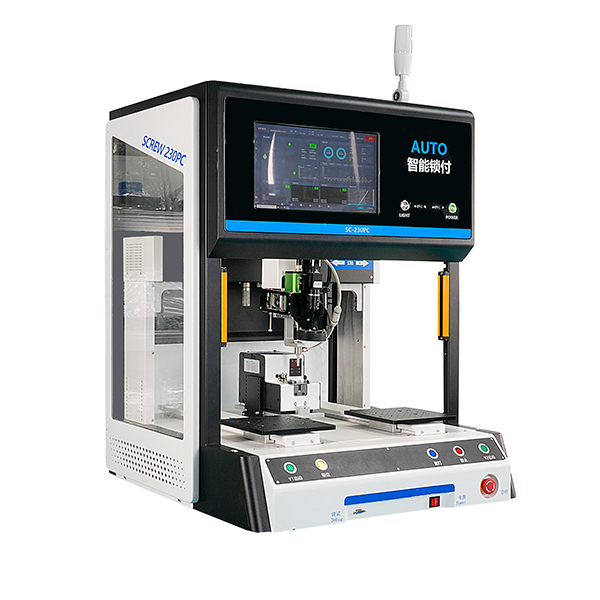
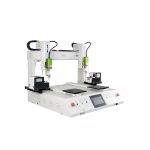
Visual Automatic Screw Locking Machine: A fully automatic intelligent equipment equipped with industrial-grade high-definition cameras and AI visual positioning algorithms. It can automatically complete screw feeding, hole position recognition, positioning, and locking without manual intervention. It is a “full automation” solution that focuses on precision and high efficiency, suitable for large-scale, high-precision production scenarios.

Key Differences: Advantages Comparison
The core differences between handheld and visual automatic screw locking machines lie in their operational mode, efficiency, precision, and cost. Below is a detailed comparison of their unique advantages, helping you quickly grasp their core value:
1. Handheld Screw Locking Machine: Advantages of Flexibility and Cost-Effectiveness
The handheld screw locking machine is designed to solve the pain points of small-batch, multi-variety production and flexible operation. Its core advantages are concentrated in flexibility, simplicity, and high cost performance, which are very friendly to small and medium-sized enterprises and scenarios with frequent product changes:
Strong Flexibility, Wide Compatibility: It has a small size and light weight (the whole machine is about 9-10kg, and the handpiece is about 0.8kg), which can be operated with one hand and easily moved between different production lines or workstations. It is compatible with M1-M6 screws of various types (cross, flat, hexagonal) and lengths, and can quickly switch between different screw specifications without complex debugging, perfectly adapting to multi-variety production needs.
Simple Operation, Low Threshold: No professional programming or technical training is required. Operators can master the operation skills within 10 minutes—just hold the handpiece, align the screw hole, and press to complete the locking动作. It effectively reduces the training cost and the impact of employee turnover on production.
Cost-Effective, Quick ROI: Compared with visual automatic models, the investment cost is 50-70% lower, and the price is more friendly to small and medium-sized enterprises. It can replace 1-2 manual workers, save labor costs, and the investment return cycle is only 3-4 months, which is a cost-effective choice for enterprises with limited budgets.
Suitable for Narrow Spaces and Special Workpieces: Its portable design allows it to enter narrow spaces (such as the interior of automobile parts and small electronic enclosures) that automatic equipment cannot reach, and it can flexibly adapt to irregularly shaped workpieces that are difficult to fix with fixtures, avoiding the problem of workpiece damage caused by rigid positioning.
Stable Performance, Easy Maintenance: It adopts industrial-grade components and a modular design, with low failure rate and simple daily maintenance—only regular cleaning and lubrication are required. Even if a jam occurs, non-professional personnel can solve it in a few seconds. The noise is lower than 60 decibels, which is friendly to the workshop environment.
2. Visual Automatic Screw Locking Machine: Advantages of Precision and High Efficiency
The visual automatic screw locking machine is an intelligent upgrade of the screw locking process, focusing on solving the pain points of low efficiency, poor precision, and high labor cost in large-scale production. Its core advantages are concentrated in intelligence, high precision, and high efficiency:
Intelligent Visual Positioning, High Precision: Equipped with high-resolution industrial cameras and AI visual algorithms, it can real-time identify the position of screw holes, automatically calculate the locking coordinates, and adjust the locking angle and depth, with a positioning accuracy of ±0.02mm. It can effectively avoid quality problems such as missing locks, floating locks, sliding teeth, and deviation caused by manual operation, and the product qualification rate can reach 99.9% or more.
Fully Automatic Operation, High Efficiency: The whole process from screw feeding, positioning to locking is completed automatically without manual intervention. The locking speed can reach 0.5-1.25 seconds per screw, and the hourly output is 3-5 times that of handheld models and 10 times that of manual operation. It can work continuously for 24 hours, greatly reducing downtime and significantly improving production capacity.
Intelligent Monitoring and Data Traceability: It is equipped with torque sensors and intelligent monitoring systems, which can real-time detect locking quality (such as over-tightening and under-tightening) and issue an automatic alarm for abnormalities. It supports data recording and uploading to the MES system, realizing full-process quality traceability, which is suitable for industries with strict quality requirements such as automotive and medical devices.
Low Labor Dependence, Cost Saving in the Long Run: One machine can replace 3-4 manual workers, completely solving the problems of high labor cost, high turnover rate, and fatigue in manual operation. Although the initial investment is higher, it can save a lot of labor costs in the long run, and the ROI cycle is about 6-8 months for large-scale production enterprises.
Flexible Adaptation to High-Precision and Complex Scenarios: It can flexibly adapt to the locking of micro screws (such as M0.6-M1) and complex workpieces (such as curved surfaces and special-shaped parts), and can quickly switch product parameters through programming, adapting to the needs of small-batch and multi-variety flexible production.
Application Scenarios: How to Choose Correctly?
The choice between handheld and visual automatic screw locking machines depends on your production scale, product precision requirements, and production mode. Below are their typical application scenarios, helping you make accurate decisions:
1. Typical Application Scenarios of Handheld Screw Locking Machine
It is mainly suitable for small-batch, multi-variety, flexible production, and scenarios that require manual intervention or narrow operation space. Common application industries and scenarios include:
Small-Batch Production Enterprises: Such as small and medium-sized electronic factories, toy factories, and hardware processing factories, which have small production batches, frequent product changes, and limited budgets, and need cost-effective and flexible equipment to complete the screw locking process.
Irregular Workpieces and Narrow Spaces: For example, the assembly of automobile interior parts (sun visors, door panels), the maintenance of household appliances, the assembly of small electronic products (earphones, remote controls), and other scenarios where automatic equipment cannot reach or is difficult to fix the workpiece.
Workshops with Low Automation Degree: Factories that have not yet completed full automation transformation, need to cooperate with manual operation to complete the assembly line, and require equipment that is easy to operate and quick to put into use without major modifications to the existing production line.
Multi-Scenario Mobile Operation: Such as on-site maintenance, temporary assembly tasks, and scenarios where the production line needs to be moved frequently. The portable design of the handheld model can meet the flexible operation needs.
Industries with Low Precision Requirements: Such as furniture assembly, plastic product assembly, and simple hardware assembly, where the requirements for screw locking precision are not high, and flexibility and cost performance are the core demands.
2. Typical Application Scenarios of Visual Automatic Screw Locking Machine
It is mainly suitable for large-scale, high-precision, and fully automated production, and scenarios with strict quality requirements. Common application industries and scenarios include:
Large-Scale Mass Production Enterprises: Such as 3C electronic factories (mobile phones, tablets, laptops), automotive parts factories, and LED lighting factories, which have large production batches, high production efficiency requirements, and need to reduce labor dependence and ensure stable product quality.
High-Precision Product Assembly: For example, the assembly of microelectronic components (circuit boards, chips), the locking of automotive electronic modules (central control screens, radar modules), and the assembly of precision medical devices, which require high positioning precision and torque consistency, and cannot tolerate manual errors.
Fully Automated Assembly Lines: Factories that have completed the transformation of intelligent workshops, need to connect with other automatic equipment (conveyors, manipulators) to form a fully automated assembly line, and realize unmanned production in the whole process of screw locking.
Industries with Strict Quality Traceability Requirements: Such as the automotive industry (complying with IATF 16949 standard), medical device industry, and high-end electronic industry, which require real-time recording of locking data for quality traceability and after-sales management.
Complex Workpiece Assembly: For example, the assembly of curved surface workpieces, special-shaped parts, and products with hidden screw holes, where visual positioning technology can accurately identify hole positions and complete locking without damaging the workpiece.
Summary: How to Choose Between the Two?
Both handheld and visual automatic screw locking machines have their own advantages and applicable scenarios. There is no absolute “better”, only “more suitable”. Here is a simple choice guide for you:
Choose handheld screw locking machine if: You have small production batches, frequent product changes, limited budget, need flexible operation, or the workpiece is irregular/narrow in operation space.
Choose visual automatic screw locking machine if: You have large production batches, high precision requirements, need to reduce labor costs, realize full automation, or require strict quality traceability.
As a professional automation equipment manufacturer, Dongguan Sudizhi provides both handheld and visual automatic screw locking machines, and can customize solutions according to your specific production needs (screw specifications, workpiece types, production scale). All products have passed CE, ISO 9001, and IATF 16949 certifications, complying with international standards, and providing global after-sales support to solve your worries about equipment use.
FAQs (Optimized for Google Search)
Q1: Can the handheld screw locking machine be used for large-scale production?
A1: It is not recommended. The handheld model relies on manual operation, and its efficiency is limited by the operator’s speed and physical strength. It is more suitable for small-batch and multi-variety production. For large-scale production, the visual automatic model can achieve higher efficiency and stability.
Q2: Is the visual automatic screw locking machine difficult to debug and maintain?
A2: No. Sudizhi’s visual automatic screw locking machine is equipped with an intuitive touch screen operation panel, and product parameter switching can be completed in 30 minutes to 1 hour. The core components adopt international brands (Panasonic, Mitsubishi), with low failure rate, and we provide free online technical training and lifelong maintenance support.
Q3: Are both machines compatible with different types of screws?
A3: Yes. Both handheld and visual automatic models are compatible with M1-M6 screws of various types (cross, flat, hexagonal) and lengths. The visual automatic model can also adapt to micro screws (M0.6-M1) and is more suitable for high-precision screw locking.
Q4: What is the service life of the two machines?
A4: Under normal maintenance, the service life of both machines is 5-8 years. The handheld model has simple structure and low maintenance cost; the visual automatic model uses high-precision components, and regular maintenance can ensure long-term stable operation.
Contact us today to tell us your production needs, and our professional team will provide you with a tailored screw locking solution, helping you choose the most suitable equipment and upgrade your assembly line efficiency!
Dongguan Sudizhi Automation Equipment Co., Ltd.
Your Trusted Partner for Smart Assembly Solutions
Leave a Reply